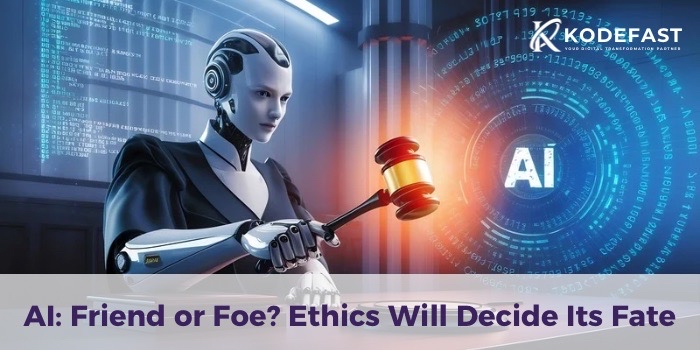
AI: Friend or Foe? Ethics Will Decide Its Fate
Artificial Intelligence is transforming our world at a pace once thought impossible. From the phones in our hands to the smart systems in our homes, and from business boardrooms to hospital corridors, AI has become inseparable from modern life. In healthcare especially, it acts like a trusted friend supporting doctors in making life-saving decisions, analyzing medical scans with unmatched precision, and even accelerating the discovery of new treatments. Yet, just as easily, it can become a hidden danger, amplifying bias, eroding privacy, and putting at risk the very people it was designed to help.
The great question is this: Is AI truly a friend to humanity, or a foe in disguise? The answer will never come from machines themselves, but from the ethics and conscious choices we embed into their design. Only through responsible AI development and adherence to an ethical AI framework can we ensure that this technology remains a partner rather than a threat.
The Friendly Face of AI
The contributions of AI to healthcare are already extraordinary. Consider the efficiency of a system that can process millions of medical images in seconds, catching subtle signs of disease that the human eye might miss. Think of its ability to predict when critical medical equipment is likely to fail, or to detect fraud in healthcare billing before it spirals into loss. AI extends access where it was once impossible. Telemedicine now connects doctors with patients in remote villages, while AI-driven chatbots provide instant guidance at any time of the day.
But AI is not only about scale; it is also about intimacy. It creates personalized treatment plans, tailors health recommendations, and even adjusts learning experiences for medical students, all with remarkable precision. And in the world of discovery, its role is nothing short of transformative driving breakthroughs in drug research, mapping disease patterns, and modeling the impacts of climate on human health. In these ways, AI feels less like a tool and more like a supportive friend, quietly expanding the possibilities of care, knowledge, and innovation.
The Foe in the Machine
Yet beneath the optimism lies a more complex truth. AI’s power is double-edged, and without strong ethical considerations in AI implementation, it can turn against us. Bias is a dangerous adversary: when AI is trained on unrepresentative or flawed data, it perpetuates discrimination. In healthcare, that can mean misdiagnosis for patients from underrepresented groups, or unfair treatment recommendations. These failures are not technological they are ethical.
Privacy, too, is under constant threat. The sensitive health records that fuel AI innovation also expose patients to risks if misused. Without privacy preservation in AI-driven applications and strong commitments to AI privacy ethics, even the most advanced systems may erode the trust that is the foundation of healthcare.
Transparency is another challenge. Too often, AI operates like a black box, producing decisions with no explanation. This lack of clarity undermines AI accountability and leaves patients and doctors alike unable to understand or challenge the logic behind critical medical decisions. Overreliance only compounds the danger: as doctors depend more on machines, their own critical judgment risks being dulled, turning trust into complacency. And all the while, AI systems themselves remain vulnerable to cyberattacks, creating urgent risks for data privacy and security in healthcare applications.
Without safeguards, AI can quickly transform from a helper into a foe, causing more harm than hope.
Ethics - The Real Deciding Factor
At the heart of the debate lies a simple truth: AI has no moral compass of its own. It mirrors the values, blind spots, and priorities of those who build and deploy it. That is why ethical AI implementation is not optional it is the only way forward.
An AI accountability framework must ensure that humans remain in control, especially when lives are at stake. AI transparency should be a standard, so patients and providers can trust and understand how decisions are made. Commitment to AI fairness means systems must be trained and tested with diverse, representative data, ensuring they work for everyone, not just a privileged few. And most importantly, AI privacy ethics must remain central, guaranteeing that personal information is safeguarded with dignity and respect.
In the end, an ethical AI framework is not just about rules; it is about building trustworthy AI systems that serve humanity’s long-term well-being rather than short-term profit. Ethics is the steering wheel, guiding AI safely along the road to progress instead of into a future defined by harm.
The Choice Before Us
AI is neither inherently good nor inherently bad. It is a reflection of our priorities, our greed, our compassion, and our courage. Driven by profit alone, it could become a weapon of division and exploitation. Guided by ethics, fairness, and privacy preservation, it could become the greatest ally healthcare has ever known.
The choice does not belong to machines. It belongs to us governments, innovators, healthcare leaders, and everyday individuals. The question remains: Will AI be the friend that empowers us, or the foe we fear? The answer will be written not in code, but in the ethics we choose today.